
Google finished its November 2026 core update on 24 November after 13 days and 20 hours. Within hours it pre-announced a December core update aimed at longer, more complex questions and personalised results. At Wevlopers we spent the last few days reviewing Search Console data and talking to other SEOs. The pattern is clear: sites that scaled with unreviewed AI pages and near-identical templated folders lost the most, while genuine brand and product pages held or gained.

Consultants tracking the update (including analysis shared on The Edward Show) repeatedly named three groups that lost visibility: folders built from one template repeated thousands of times, sites that published thousands of unreviewed AI-written pages, and lead-generation sites in finance, health and law. Official brand sites and original data sources generally stayed stable. Reddit itself saw estimated Google clicks drop around 25% according to the figures cited.
What “look-alike” pages actually means
These are not normal category or location pages. They are the pages where only a single variable changes: one page per area code, one page per “X versus Y” pairing, one page per dictionary word, one city page that is 95% identical to the next. Lily Ray and others pointed to entire subfolders and subdomains that dropped because they were one template repeated at scale. Doorway-style pages aimed at searches that have little to do with what the business actually sells were especially exposed.
At Wevlopers we have seen the same pattern with clients who previously built programmatic “city + service” or “comparison” sections. When the content adds no unique information, no real experience and no clear reason for a visitor to stay, Google now has stronger systems to detect and down-rank it. Mass AI content without human review falls into the same bucket.
Why this matters for AI Overviews and the December update
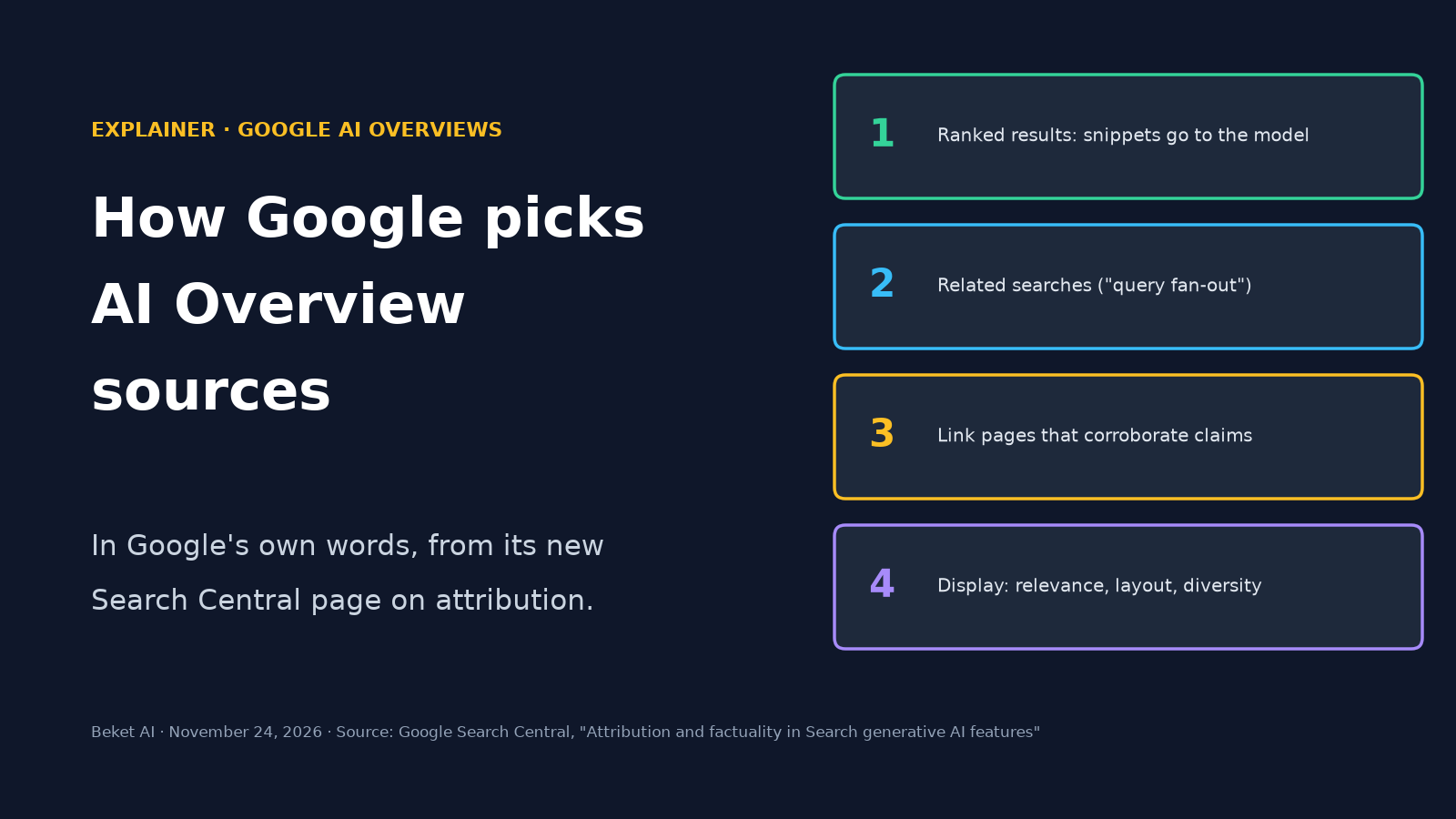
On the same day the November update finished, Google published clearer documentation on how AI Overviews and AI Mode choose sources. The first step is still the ranked results for the query. Snippets from those pages go to the model. The system may then run related searches (query fan-out), check which pages actually support specific claims, and only then decide which links to show. Pages that are not indexed, not snippet-eligible, or excluded from generative AI features in Search Console cannot appear as supporting links.
That means ranking well in regular Search still matters for AI visibility. The December update is expected to improve how Google handles longer and more complex questions. Thin, templated pages will struggle even more with those queries. Personalised results for opted-in users will further reward content that matches real user intent rather than keyword permutations.
Practical fixes we recommend right now
1. Audit the folders that look identical. Open Search Console, filter to the subfolders or subdomains that lost the most clicks since mid-November, and list every URL that is essentially the same template. If a page only swaps a city name, area code or product pair and adds no unique data, examples or experience, it is a candidate for noindex, consolidation or removal.
2. Review every AI-written page. AI as a drafting assistant is fine. Publishing thousands of unreviewed pages is not. Check for generic structure, missing original insight, thin supporting evidence and facts that do not match your actual service. Improve or remove the weakest ones. Add clear authorship, sourcing and an About page so Google (and users) can see real experience.
3. Strengthen the pages that already work. Brand pages, core service pages and any content with original data, case studies or real customer examples held up better. Double down on those. Make sure they answer longer, more specific questions that the December update is likely to surface.
4. Check your AI controls and technical basics. In Search Console confirm that generative AI features are not blocked unless you intentionally want them off. Keep pages indexable and snippet-eligible. Google also clarified that most 404s do not need fixing and do not drain crawl budget; a 410 generally leads to less frequent crawling. Do not waste time on every old 404 unless it is important.
5. Prepare content for complex queries. Instead of another “best X for Y” template page, write one thorough piece that covers the real decision process, costs, timelines, common mistakes and what good results look like for your customers in India, Australia, the UK, USA or UAE. Original research, clear comparisons based on your own data, and practical checklists outperform another set of look-alike pages.
What to watch in the next two weeks
Give Search Console at least 7–14 days after 24 November before drawing firm conclusions. Compare the two-week period before the update started with the period after it finished. Look at both clicks and impressions, and check whether AI Overview impressions appear in the Generative AI performance report. If your main commercial pages are stable and only the scaled content folders dropped, the update did what many of us expected.
The December update is not live yet. Use the time to clean the obvious look-alike and unreviewed AI content rather than waiting for another drop. Sites that keep publishing useful, experience-based pages will keep winning both regular results and AI citations.
If your site lost visibility in the November update or you want a clear plan before the December one lands, Wevlopers can review your Search Console data and content structure and show you exactly which pages to keep, improve or remove. Book a free audit and we will walk you through the priorities for your market.


