
Google started rolling out its November 2026 core update on 10 November. As of 21 November, it is still active and Google has said it may take up to two weeks. For most small and medium businesses, the smartest move right now is simple: watch the numbers, fix real problems, and avoid big changes until the dust settles.
At Wevlopers we see this pattern every core update. Rankings move for a few days, some owners panic and rewrite pages, and then the data settles. The businesses that stay calm usually come out ahead. Wevlopers works with clients across India, Australia, the UK, USA and UAE, and the advice is the same everywhere: measure properly before you act.
What Google actually said
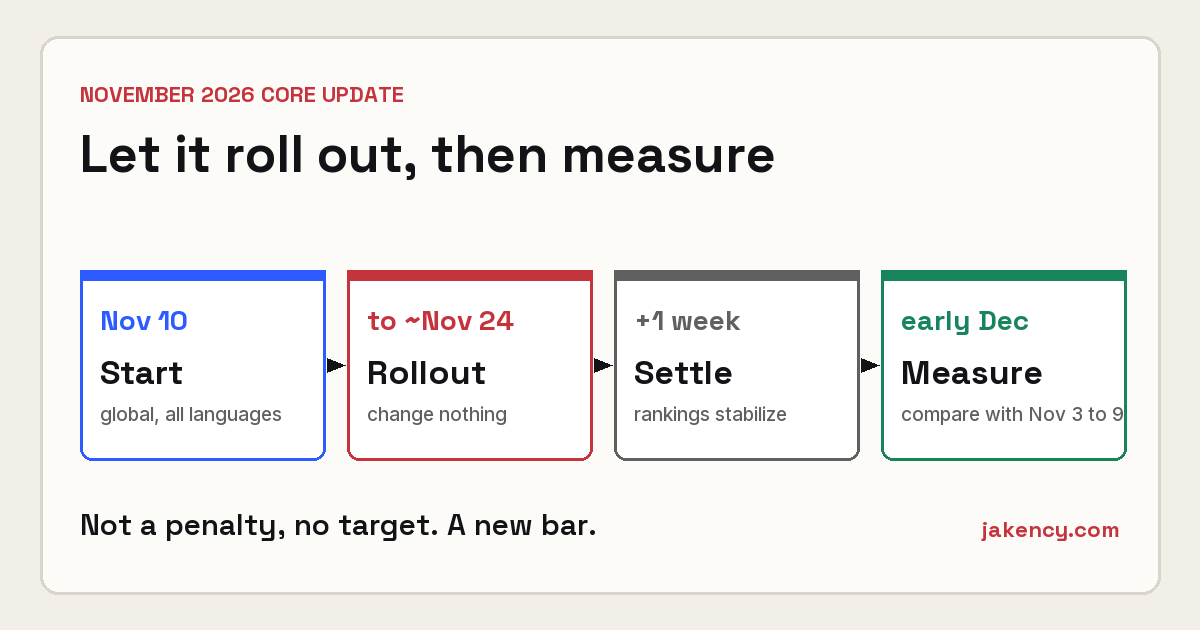
Google announced the update on its Search Status Dashboard on 10 November at 10:06 Pacific time. The note is short: it applies globally and to all languages, and the rollout may take up to two weeks. There is no target list and no special advice beyond the normal core update guidance.
Two days later Google also switched the default model in AI Mode to Gemini 4 Hydrogen. That change affects how AI answers are built, but it is separate from the core ranking update. Treat them as two different things happening at the same time.
What not to do while it is still rolling out
Rankings can swing up and down while an update is in progress. Changing pages based on a single day’s data usually makes the picture worse, not better.
Avoid these actions right now:
- Rewriting titles or content on pages that were performing well before 10 November
- Deleting or noindexing pages just because traffic dipped for a couple of days
- Buying links or running a full disavow in a panic
- Changing URL structures or doing a big site redesign
Do fix genuine technical problems the moment you spot them: broken contact forms, accidental noindex tags, server errors, or pages that return the wrong status code. Those issues are not caused by the core update and they cost you leads every day.
How to set a clean baseline
Export your Search Console data for the week of 3–9 November now, while it is still easy to find. That is the last full week before the update started. Note the numbers for clicks, impressions, average position and, if you have it, the Generative AI performance report.
Also record your real business metrics for the same week: phone calls, form fills, quote requests and orders. Rankings are secondary. Enquiries are what matter.

When and how to measure the impact
Google’s own advice is clear: wait until the rollout is marked complete on the Search Status Dashboard, then wait at least one full additional week before you compare numbers.
If the update finishes around 24 November, your first clean comparison week will land in early December. Compare that week with 3–9 November. Look at both the main Performance report and the Generative AI report separately. AI Overviews and AI Mode impressions are already included in the main report, so do not add the two numbers together.
A small drop (for example position 2 to 4) is normal. A large, sustained drop (position 4 to 20+) is a signal to review the page against Google’s helpful content questions. Ask whether the page still answers the query better than the new top results, and whether it shows real experience.
Practical checklist for the next two weeks
This week:
- Export Search Console data for 3–9 November (pages and queries)
- Note your enquiry numbers for the same period
- Check the Search Status Dashboard every couple of days
- Fix only real technical errors
- Keep publishing the content you already had planned
After the update is marked complete:
- Wait one full week
- Compare the settled week with 3–9 November
- Review pages with large sustained drops
- Improve those pages with better answers, clearer experience and up-to-date facts
- Check your Generative AI impressions to see which pages Google is already using in AI answers
For local businesses, also keep your Google Business Profile accurate. Hours, services, phone numbers and review responses should match what is on your website. AI features are increasingly drawing on profile data, so mismatches create friction.
Bottom line
The November 2026 core update is a normal ranking refresh. It is not a penalty and it is not aimed at any particular industry. Most small businesses will see modest movement. The ones that measure carefully and improve the pages that truly need it will recover faster than those that chase every daily fluctuation.
If your traffic has dropped and you are not sure whether it is the update or something else, Wevlopers can run a free audit of your Search Console data and Google Business Profile. Drop us a message and we will take a look.


