
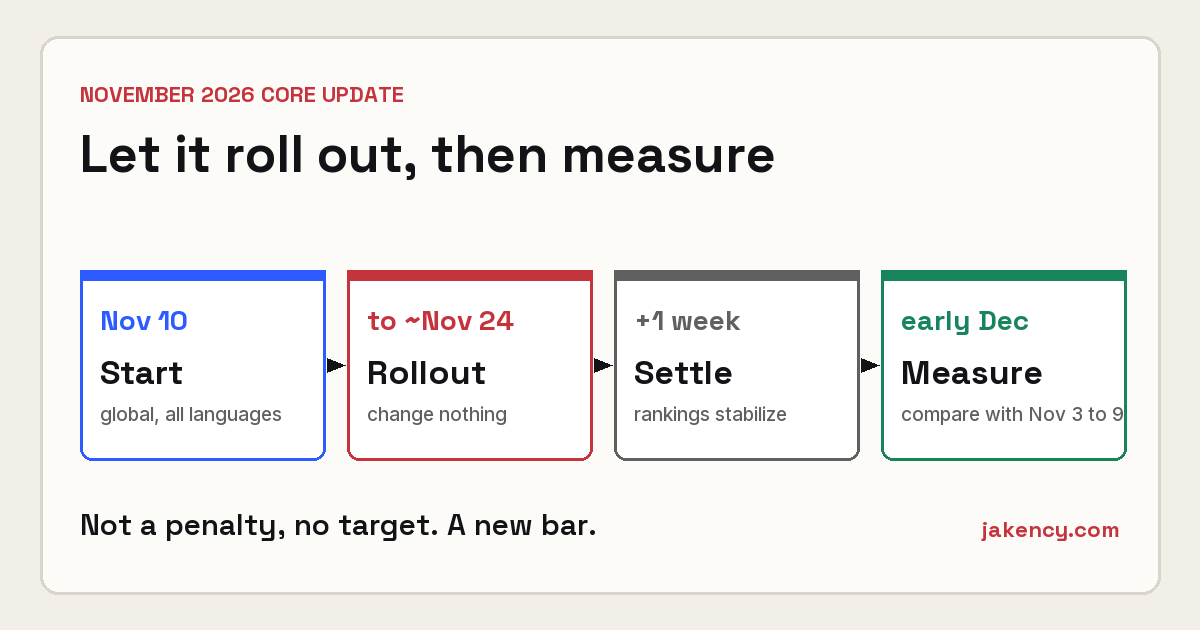
Google’s November 2026 Core Update started on 10 November at 10:06 AM Pacific and is still listed as active on the Search Status Dashboard. Google said the rollout may take up to two weeks, which puts a possible finish around 24 November. At Wevlopers we are treating this exactly like every other core update we have guided small businesses through: no panic edits, clear baselines, and focused improvements only where the data later proves they are needed.
This is the third core update of 2026 (after March and May). It applies globally and to all languages. Two days into the rollout Google also made Gemini 4 Hydrogen the default model in AI Mode and for the hardest AI Overview questions. That overlap is why many Search Console numbers look noisy right now.
What Google actually said
Google described it as a regular update designed to better surface relevant, satisfying content from all types of sites. There is no new guidance and no list of targeted sites or industries. Core updates reassess how well pages match user needs across the web. Some sites rise, some fall, and many stay roughly where they were.
Because the update is still running, any ranking or traffic movement you see today is not final. Past core updates have sometimes taken longer than the stated two weeks.
The Wevlopers checklist for the next 7–10 days
We give every client the same short list. Do these steps and leave the rest alone until the dashboard shows the update is complete.
1. Save a clean baseline now. In Google Search Console open the Performance report and export data for 3–9 November (the week before the update started). Note total clicks, impressions, average position, and your top 20 pages and queries. Add an annotation in GA4 for 10 November. Without this snapshot you will not be able to separate the update from your own later changes.
2. Fix only real technical problems. Check the Page indexing report, Crawl stats, robots.txt, noindex tags, and redirect chains. A sudden spike in errors or a site that stopped being crawled is not caused by the core update. Fix those issues immediately. Do not touch titles, content, or internal links on pages that are already performing.
3. Do not delete or mass-rewrite content. Every core update produces stories of people who deleted pages in a panic and made the drop worse. Google has repeatedly said that content which was ranking should not be removed just because of a temporary dip. If a page was useful before 10 November, leave it alone for now.
4. Watch AI Overviews and AI Mode separately. Gemini 4 Hydrogen improves query fan-out (breaking one question into multiple sub-searches) and can surface more links. Pages that answer a specific sub-question clearly, with the answer near the top and in simple language or tables, have a better chance of being cited. Check a few of your important queries in AI Mode and note which sources appear. This is extra visibility work, not a ranking change.
5. Annotate and wait. Once Google marks the rollout complete on the Search Status Dashboard, wait at least one full additional week. Then compare that week with your 3–9 November baseline. Look at Web Search, Images, Video, News and Discover separately. Small position moves (for example from 2 to 4) usually need no action. Larger, sustained drops need a proper review against Google’s people-first content questions.
How this update intersects with AI search
BrightEdge data showed AI Overviews on 85% of US eCommerce searches in November, up from 24% in April. Local packs still appear on the vast majority of local queries. For most small businesses the practical reality is that both classic rankings and AI answers now matter.
At Wevlopers we continue to recommend the same fundamentals that have worked across previous core updates:
- Clear, first-hand answers near the top of important pages
- Genuine experience, photos, and specific details that generic AI content cannot fake
- Strong Google Business Profile data that matches the website
- Fast, clean pages that are easy for both people and Google to read
These practices help both traditional rankings and the chance of being cited in AI Overviews or AI Mode.
What to do after the update finishes
When the dashboard shows the rollout is complete:
- Wait one full week.
- Compare the settled week with 3–9 November in Search Console.
- Identify pages that dropped significantly and compare them with the pages that now rank higher.
- Improve only the pages that have clear gaps in usefulness, originality or experience.
- Keep publishing new helpful content. New pages are fine; rewriting existing winners is not.
For retailers the timing is especially important. Thanksgiving is 26 November and Black Friday is 27 November. Year-on-year comparisons will be needed later to separate the update from normal seasonal traffic.
Final practical note
Core updates are not penalties. They are re-rankings based on Google’s current understanding of what is most useful. The sites that recover fastest are usually the ones that stayed calm, kept good data, and then made targeted improvements instead of broad rewrites.
If your Search Console numbers look confusing or you want a second pair of eyes on the baseline and the pages that moved, Wevlopers offers a free SEO audit for small and medium businesses. We will look at the data with you and give a clear next-step plan without the panic.


