
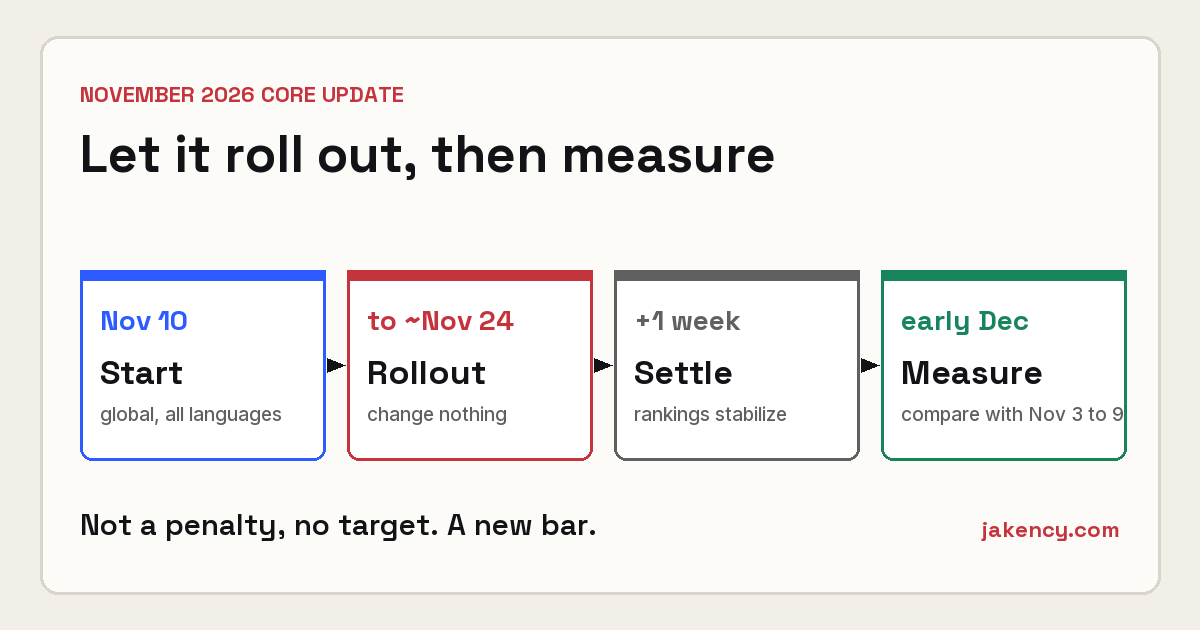
Google started rolling out its November 2026 core update on November 10 at around 10:06 a.m. Pacific Time. The update is global, applies to every language, and Google says the rollout may take up to two weeks to complete. At Wevlopers we work with small and medium businesses every day, and the advice is always the same: do not panic, do not make sudden changes, and focus on what you can control. This is the third broad core update of 2026, coming after the March and May updates, and it lands just before the busy holiday shopping period in the US, UK, Australia and other markets.
Wevlopers has seen enough core updates to know that the sites which hold or improve their positions are the ones that already serve real users with clear, useful content. If your rankings drop in the next two weeks it is almost never a penalty. It is Google reassessing which pages best answer queries right now.
What Google Has Officially Said
On the Google Search Status Dashboard the entry reads: “Released the November 2026 core update, which applies globally and to all languages. The rollout may take up to 2 weeks to complete.” Google Search Central also posted on LinkedIn calling it “a regular update designed to better surface relevant, satisfying content for searchers from all types of sites.”
There is no special target. Google has not named any industry, content type or tactic. That means the advice that worked after previous core updates still applies. Wait for the rollout to finish, then wait at least one full week after completion before you compare numbers.
What You Should Do Right Now
Here is the practical checklist Wevlopers recommends for local service businesses, healthcare clinics, real estate agents, home service companies and e-commerce stores:
1. Annotate the date. Mark 10 November 2026 in your Search Console notes or analytics. Any ranking movement you see after this date is potentially related to the update.
2. Do not make big changes. Avoid rewriting titles, deleting pages, or changing technical setup while the update is rolling out. Sudden changes make it harder to see what the update actually did.
3. Keep publishing helpful content. Continue answering the real questions your customers ask. Clear H2 headings, short paragraphs, specific examples and original data still matter.
4. Check your Google Business Profile. Local packs and Maps results can also shift. Make sure your name, address, phone, categories, photos and recent reviews are accurate.
5. Monitor Search Console, not just rank trackers. Rank trackers can show volatility during a rollout. Look at clicks, impressions and average position in Search Console once the update is done.
How to Measure the Impact Correctly
Google’s own guidance is simple. After the rollout finishes (expected around 24 November if it uses the full two weeks), wait at least seven more days. Then compare that full week against the week of 3–9 November (the week before the update started).
Use the Compare feature in Search Console. Look at pages and queries that matter most to your business. A drop in one or two rankings is normal. A large, sustained drop across many pages usually points to content that no longer satisfies users as well as competing pages.
AI Overviews and AI Mode During the Update
Google also rolled out Gemini 4 Carbon to AI Mode for AI Ultra subscribers around the same time. AI Overviews continue to appear on a large share of searches. For small businesses this means two things: keep your content clear and extractable so it can be cited, and still optimise for the traditional blue links and local pack because most commercial clicks still come from there.
Wevlopers recommends treating AI visibility as an extension of good SEO rather than a separate project. Strong pages that answer questions directly tend to appear in both places.
Common Mistakes to Avoid
Do not disavow links just because rankings moved. Do not buy cheap backlinks hoping to “recover.” Do not rewrite every page with AI tools in a rush. Do not ignore your Google Business Profile while you focus only on the website. These reactions rarely help and often create new problems.
What Happens Next
Once Google marks the update complete on the Search Status Dashboard, set your comparison dates and review the data. If you see real losses on important pages, look at whether those pages still fully answer the query better than the new top results. Add missing details, improve clarity, or expand coverage of related questions. Most recoveries happen through better content and cleaner user experience, not through technical tricks.
If you want a second pair of eyes on your Search Console data or a practical plan for your local or national pages, the team at Wevlopers can help. We focus on real results for small and medium businesses rather than chasing every ranking fluctuation.
Want a free review of how your site is holding up during this core update? Get in touch with Wevlopers and we will take a look.


