
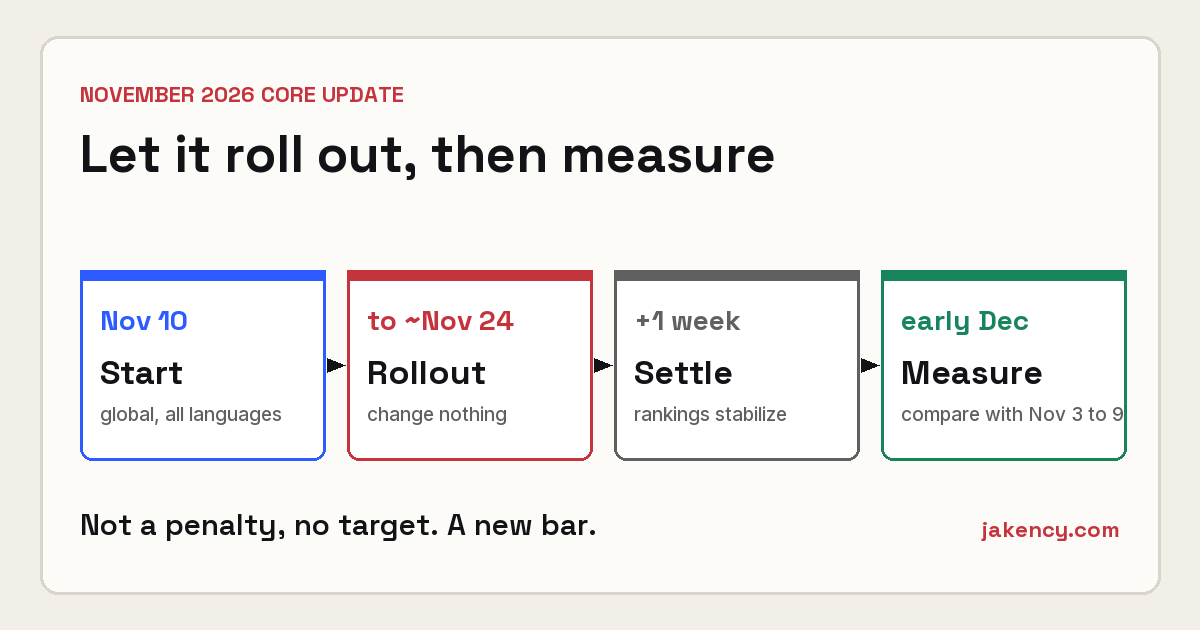
Google started rolling out its November 2026 Core Update on 10 November. It applies worldwide, to every language, and may take up to two weeks to finish. At Wevlopers we have already started tracking client sites in India, Australia, the UK and the USA. Rankings will bounce while it rolls out. That is normal. The useful work right now is simple: record a clean baseline, fix only real problems, and wait before you judge anything.
Wevlopers has handled multiple core updates for service businesses. The pattern is always the same. Sites that keep publishing useful pages and keep their Google Business Profiles accurate usually recover faster than sites that start rewriting everything mid-rollout. This post gives you the exact steps we recommend this week.
What Google actually said
Google’s own message on the Search Status Dashboard is short: this is a regular update designed to better surface relevant, satisfying content for searchers from all types of sites. The rollout may take up to two weeks. It is not a penalty. It does not target any industry. It simply re-scores how well pages answer queries compared with everything else that has been published since the last core update in May.
At the same time, Google rolled out Gemini 4 Hydrogen as the default model in AI Mode and for the hardest questions in AI Overviews. Robby Stein called it the biggest model upgrade to Search yet. The new model is better at understanding multi-part questions and typos, and it runs more simultaneous sub-queries. That means AI Overviews will cite a wider set of sources. Your organic rankings and your AI visibility can move independently.

What to do this week (the practical checklist)
1. Export your baseline now. In Google Search Console, export Performance data for 3–9 November (the week before the update started). Save clicks, impressions and average position by page and by query. Annotate the date in GA4 as well. You will need this later.
2. Watch real business metrics, not just rankings. Count calls, form fills, quote requests and orders for the same week. Rankings can swing while the update is still rolling out. Leads tell you more.
3. Fix only genuine problems. Broken contact forms, pages returning errors, accidental noindex tags, wrong prices, or a hacked page — fix those immediately. Everything else can wait.
4. Do not rewrite or delete pages yet. Google has repeatedly said not to make quick fixes or delete content after a small drop. If you change titles, content or URLs now, you will never know whether the update or your edit caused the movement.
5. Check your Google Business Profile. Make sure name, address, phone, hours, categories and photos are accurate. Reply to recent reviews. The core update and local results can move together.
6. Keep publishing planned content. Continue with the pages or posts you already had scheduled. Fresh, useful content still helps once rankings settle.
When to measure and what to look for
Wait until Google marks the update complete on the Search Status Dashboard. Then wait at least one full additional week. Compare that settled week with your 3–9 November baseline. Look at:
- Which pages gained or lost clicks
- Which queries moved
- Whether AI Overviews started citing your pages (or stopped)
- Any change in local pack visibility
A drop of one or two positions is usually not worth major work. A large, lasting drop on your main money pages is a signal to review those pages against Google’s helpful-content questions: does the page fully answer the searcher’s need, is the information accurate and up to date, and is the experience better than the alternatives?
Here is a short video that covers the same guidance in under seven minutes:
What this means for AI search visibility
Gemini 4 Hydrogen improves query fan-out. That can surface more sources inside AI Overviews. Pages that already answer questions clearly, use specific numbers, include expert quotes or original data, and load quickly have a better chance of being cited. Wevlopers clients who keep their service pages focused on one clear job (for example “emergency plumber in Melbourne” or “dental implants in Dubai”) tend to hold or gain both organic and AI visibility after these updates.
If you sell online, remember that Black Friday falls inside the measurement window for many markets. Compare year-over-year as well as the pre-update week so holiday traffic does not confuse the picture.
Final practical advice
Most small and medium businesses will see only minor movement. The sites that lose the most are usually the ones that panic and make large changes while the update is still rolling out. Record your baseline, keep doing the work that was already planned, and review properly once Google says the rollout is finished.
If you want a second pair of eyes on your Search Console data or a quick check of how your pages look inside AI Overviews, Wevlopers offers a free audit. Just reach out and we will take a look.


