
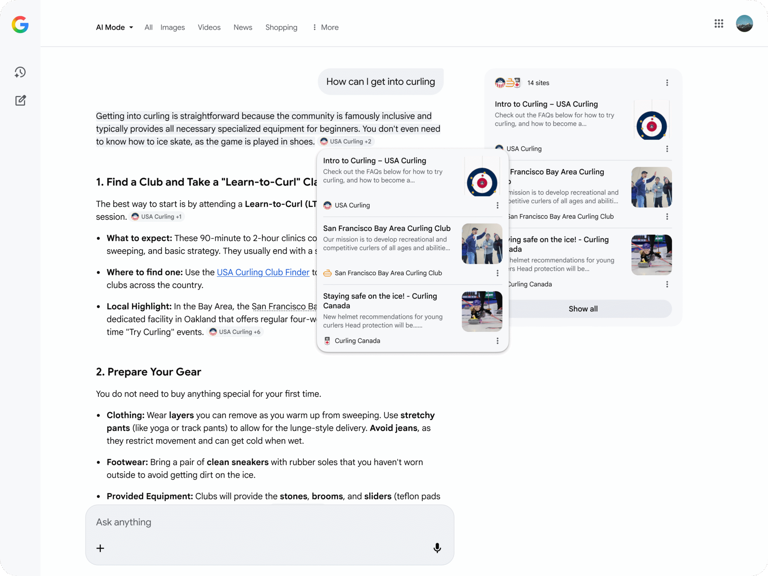
Google announced updates on 15 October 2026 that make links easier to spot and click inside AI Overviews and AI Mode. Inline links now appear higher in responses more often, and Google is testing a top section that highlights one or two official pages for specific tasks. Preferred Sources carousels are expanding, and the “Dive Deeper” section is getting image thumbnails.
For local businesses this is useful news. AI answers still pull from real web pages, and more visible links can mean more clicks when your page is the clear, trusted source. The changes do not replace normal SEO, but they reward pages that answer questions cleanly and match what people actually need.
What Actually Changed
Google said it has already increased the number of inline links and is now placing them higher more frequently so key sources are clickable sooner. It is also testing a dedicated top section that surfaces the one or two best official pages for a task, along with short context on why each link helps.
Other updates include more visual “Dive Deeper” links with thumbnails, wider rollout of timely article carousels that highlight Preferred Sources, and tests of clickable creator names on video results inside AI Mode. Preferred Sources usage has grown 7x this year, according to Google.
Gemini 4 Argon is also live in AI Mode for Google AI Pro and Ultra subscribers. It handles multi-step follow-ups better, so conversations can move from a broad question (“best plumber near me”) to specifics (“same-day emergency call-out in this suburb, with pricing”).
Why This Matters for Local Businesses
Near-me and service queries still lean heavily on the map pack, but AI Overviews appear on many informational and “how much / how to choose” searches. Studies show local business websites already earn a solid share of AI citations, and many cited pages do not even rank in the top 10 for the same query.
When Google makes the links more prominent and higher up, the pages that answer clearly stand a better chance of being clicked. Vague or thin content gets ignored. Specific, factual pages that match the follow-up questions people actually ask do better.
Practical Steps to Take This Week
1. Make your core facts easy to extract. Put service name, area served, starting prices or price ranges, timelines, and what is included in plain text near the top of the page. Do not hide this inside images or PDFs only.
2. Answer the real follow-up questions. List the questions customers ask on the phone. Create short, direct answers for pricing factors, what affects cost, how long the job takes, and when to call. Headed sections help.
3. Keep your Google Business Profile complete and consistent. Matching name, address, phone, hours, services, and categories across your site, GBP, and other listings reduces the chance AI gets confused and recommends someone else.
4. Use HTML over pure PDFs where possible. Google converts PDFs to HTML for indexing and they can appear in AI results, but HTML pages load faster, work better on mobile, and are easier for people to use. If you must use a PDF (menu, price list, brochure), make sure the text is selectable and not just a scanned image.
5. Check what AI currently says about you. Once a month, ask AI Mode or AI Overviews the questions your customers ask. Note whether you are mentioned, which pages are linked, and what is missing. Fix gaps on your site.
6. Add clear schema and real photos. LocalBusiness or more specific schema (with areaServed, openingHours, etc.) plus genuine job photos help both traditional local rankings and AI confidence.
Quick Checklist
• Primary service pages answer “what, where, how much, how long” in the first 60–100 words.
• GBP categories, services, and description match the website exactly.
• No mismatched NAP (name, address, phone) on directories.
• Key pages are indexed and not blocked.
• You monitor AI answers for your main services monthly.
• HTML versions exist for any important PDF content.
What Not to Waste Time On
You do not need to rewrite everything for AI. Google has said good SEO is still good for generative features. Focus on clear, useful pages for the questions that drive calls and bookings. Heavy keyword stuffing or thin city pages still underperform.
Also ignore tools that promise guaranteed AI citations. Visibility comes from being the clear, consistent, fact-based source that AI can safely quote and link.
Google’s move to surface links higher is a reminder that the open web still matters. Local businesses that keep their information accurate, answer specific customer questions in plain language, and maintain a solid Google Business Profile are in the best position to benefit from the extra visibility.
If you want a quick check of how your site and Google Business Profile look to both regular search and AI answers, we offer a free audit. Just get in touch and we will show you the gaps that are easiest to fix first.


%20-%20Wevlopers.com.png)
